Showing posts with label Seaweed. Show all posts

Tuesday, August 15, 2017

Tide Pools of Fox Island

Fox Island has been around for millions of years. Thus, its surface has weathered due to water (in the form of ice, rain, and waves), wind, and organism activity.
The black, slippery cyanobacteria (Calothrix spp) covers the rock in the supralittoral zone (or splash zone). This most ancient organism is "coated with a slime that prevents them from getting dehydrated at low tide; this also makes the rocks slippery for tide pool-exploring humans." "This black stain marks the limit of high tide, as Calothrix can only tolerate salt water occasionally." 
Schmitt, Catherine. A Coastal Companion: A Year in the Gulf of Maine, From Cape Cod to Canada. Gardiner, Maine: Tilbury House Publishers, 2008. Print.

This weathering has produced depressions that form tide pools; places where water sits until high tide occurs again. Up in this area, water just splashes up from wave action.


The pools range from tiny, shallow puddles, to broad shallow depressions, to deep holes. 


Drew found one of these deeper holes that was about 12-18 inches deep. He tried using the Apeman motion camera underwater, but his attempt did not work this time. We have to keep practicing to really understand how close we can get to an object to still have it in focus. We are shooting blind, so to speak. And, it was so bright out that we couldn't look at the video that we had already taken. That just means that we're going to have to visit the beach again;-)


First I checked out this tide pool, but I wasn't satisfied with it. So, I moved further down into the slick, cyanobacteria covered section.


Because of the cyanobacteria coated rocks, it was super slippery and I couldn't get any traction with my hiking boots. So much so, that I had to inch my way to this tide pool whilst sliding along on my butt! 


Green algae (Ulva intestinalis aka Enteromorpha intestinalis), rock barnacles, red algae (Hildenbrandia spp),
and juvenile black snails (Littorina obtusata maybe;-)
Check out the oxygen bubbles produced by the photosynthesizing green algae!
I hung out at this shallower tide pool and took shots from the top of the pool. Unfortunately, I had forgotten to bring the polarizing filter (gee, we never bring quite everything we need;-), but was able to shade the surface sufficiently to capture some images. I believe the green algae is Ulva intestinalis aka Enteromorpha intestinalis? If so, this algae lives in many different habitats and takes on many different forms.


And, in these tide pools, various organisms, who can handle harsh conditions, thrive. I am not sure what the yellow, jelly-like looking organism is, that is covering the rocks. First I thought it might be related to some kind of encrusting tunicates?  Could the red, jelly-like organism be Hildebrandia spp (red crust algae?) I need to take a tide pooling course from a marine biologist. I have found a good resource blog titled, Between the tides of Nova Scotia. It has lots of photos of marine life. Another fabulous website resource is Rocky Intertidal Habitats Along The Coast of Maine, by Robert Zottoli, Professor Emeritus, Fitchburg University.

And, lastly this part of the pool with some brown algae, Fucus filliformis, fronds (I believe.)

Saturday, September 3, 2016

Off to the beach we go...Fort Popham Beach that is...

We went to the beach, via Fort Popham, because you can bring dogs there. Little did we know that dogs are no longer allowed at this state historic site beach park from April 1 - Sept. 30th. Well, we got through almost our entire walk before we heard a dog owner (there were lots of dogs on this beach) being alerted to the fact that what he was doing was illegal. We got a bit nervous because we hadn't looked at the bulletin board near the bathrooms. After returning to the parking area, we checked it out, and low and behold there was a little laminated paper sign saying "No dogs on the beach." Uh oh...we are rule followers, and we had broken the rules. Oh well, it is only 4 more weeks until we can legally go to the beach again;-(
The beach has changed significantly since we last visited it a year ago (in the winter we go to Popham Beach State Park instead.) 
Now, just a short way down the beach, there is a berm that acts as a wall down to the water. We had to climb up and over it to continue our walk. Here you can see how the water sculpts the beach over time, and gradually brings in, and pulls sand away, with each tide and each storm.
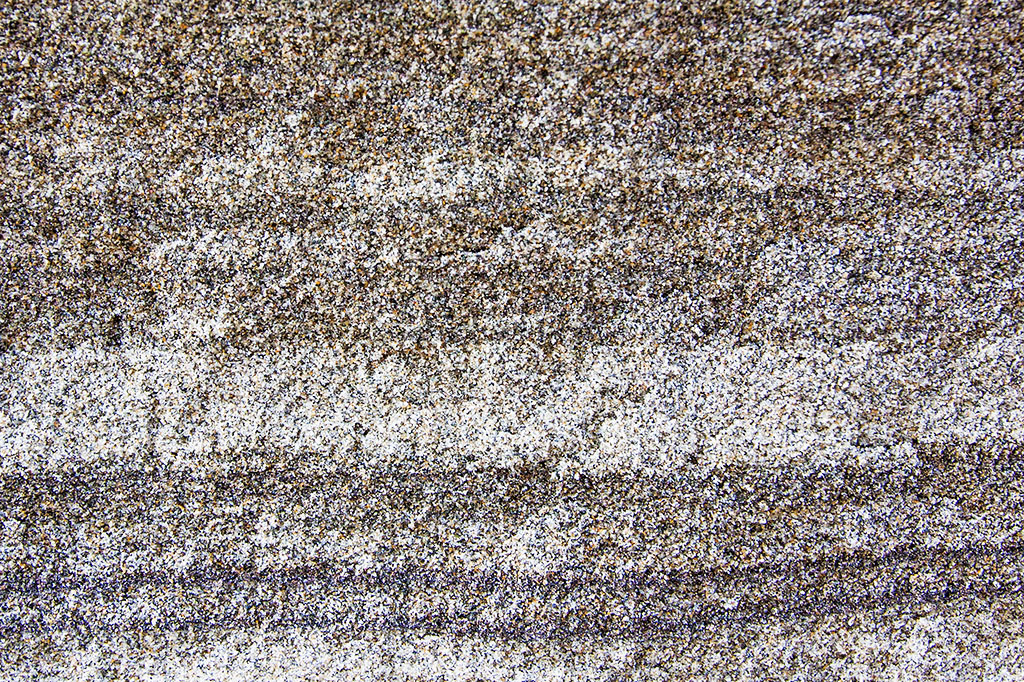
Drew pointed out the layers of sand (higher up on the beach), and indeed it is like an archaeological dig, looking into the past where the tides have brought in layer upon layer of sediment over time. This is how sedimentary rock is formed. 
Eventually, over thousands to millions of years, the bottom layer of sediment will get compacted and cemented together to form rock called sandstone. If you were able to look closely enough, you would see bits and pieces of organic material (like seaweed, crabs, etc.) mixed in with the minerals like feldspar, quartz, and mica.
As we walked along the beach, we saw lots of quahog clams which prefer to live in sandy and muddy bottoms in cold waters, which we sure have in Maine;-) By the way, they are great in chowders, soups, and stews!
This quahog has a smaller shell lodged in the sand, between its valves, that I think might be a waved whelk, but I am not sure. Check out the snail trail leading off from the shell off to the right. I wish I had picked it up to see the underside of the shell so I could try to identify it.
Then, we came across an Atlantic Dog Whelk (Nucella lapillus), also called an Atlantic Dogwinkle. Awww.. what a cute name for this predatory sea snail that feeds on barnacles, mussels, and assorted bivalves!
I was happy to find a Moon Snail on the sand and seaweeds. It's beautiful blue coloration caught my eye. They are often found in mudflats, and are truly disliked by clam diggers as they bore holes into clams and digest them. They sure are pretty, though!
Here is a pretty frond of knotted wrack. We found clumps of this seaweed along the beach where it washes up with the tides. There are literally tons of it attached to rocks along the shore and underwater. Want to know more about it? Check out a blog page by one of Bowdoin College's marine biology professors. Awesome stuff!
Jackknife clams (Ensis directus) were scattered here and there along the beach as well. On the left you see the sky blue coloration of the inside of the shell, and on the right you see the yellowish/creamy white of the outside of the shell. These clams burrow deep within the sand and mud of intertidal zones. Their shell resembles a straight razor, and the edges of the shell are so sharp that they can cut your foot if you step on them. I don't think I've ever had any to eat, but they are supposed to be delicious!
Pond Island Lighthouse is in the background
As we rounded the point (where the Kennebec River runs out into the ocean), the waves come in at two angles creating a crisscross (X) pattern.
Check out Drew's video of the wave motion.
What's a walk on the beach without seeing a few sanderlings! I finally had to remind myself to scan the shoreline for these swift little birds.
They are a type of sandpiper, and they are found almost worldwide along the ocean shorelines. 
We love watching them scurry just in front of the breaking waves. They probe the sand for tiny crabs, worms, and mollusks (to name a few burrowing animals), and eat insects as well.
Run, be free, little sanderlings! Enjoy;-)
And, then they fly low over the waves showing off their wing pattern.
I will leave you with a wide angle view of the beach...So pretty and relaxing...and one of my favorite places in Maine.