Monday, August 7, 2017

Hummingbird close-ups

Female hummer sips sugar water on the fly!

It may be just out of the camera's focus, but it is one of my favorite shots of the series
as the female arrives.

We love our little male hummer.

Male hummer
Drew has been having the intervalometer do the photography for us, and it is working out great. He set the camera (with a 70-200 mm lens + 1.4 teleconverter) on a tripod, set the intervalometer to take a photo every 2 seconds, and left it alone for an hour. Again, he taped over all but one feeding hole so the birds had to come within the focus of the camera. The camera took over 1,000 shots. Drew chose a few of the best ones. Enjoy!

Friday, August 4, 2017

We're making an Apeman Video!


We're making an Apeman Video! No, Drew is not dressing up as a gorilla! I used the Apeman 4K Action Camera (A80 model) for its first underwater trial run this afternoon. Drew put it onto a selfie stick and I held it underwater at the dock. We got a tiny bit of usable footage of smallmouth bass fry and bluegill. Fun, Fun, Fun! Next up...I think I'll try to find the underwater entrance hole to the beaver lodge;-) What does make this difficult is that I cannot see what I am shooting (especially if the water is rough or if it is dark down under:-)
Note to Shannon: "I now have an excuse to go to the beach!" Can you say "tide-pool footage?" 
Notes to self: 1. Hold the camera level.  2. Hold the camera steady   3. Don't get too close to the subject so the camera can focus   4. Go out on a calm day as the waves cause too much distraction with light shining every which way.   5. Hold the camera in one place for a few minutes before moving to a new location.   6. Pull the camera slowly out of the water and keep it steady for a final "out of the water" shot.   7. "Have patience, Grasshopper."

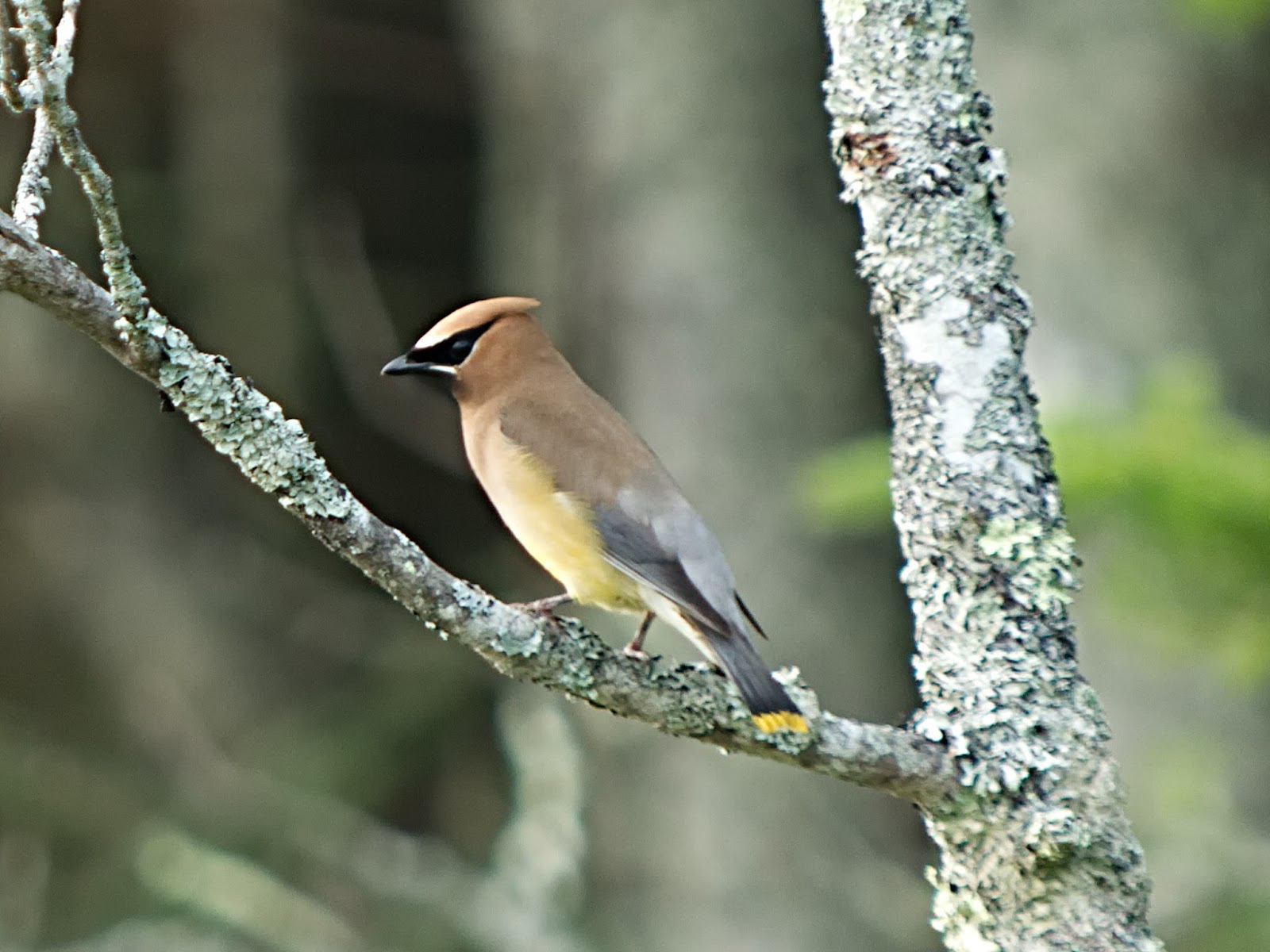
Crazy for Cedar Waxwings!

And, here are my favorite waxwing photos of the day:

My favorite photo of the day. See the red "wax" on the wing? Hence the name of the bird.
I love this shot. Too bad it isn't in focus. But...it is still nice to see how colorful cedar waxwings are!
Doesn't it look like the bird dipped the tip of its tail in yellow paint?

Cedar Waxwing eats dragonfly


Gotta maneuver my food for ease of swallowing!
While we were photographing several waxwings, I saw one swoop down, snag a dragonfly and fly up to dead tree out in the bog. Mind you, the bird was at maximum zoom for the camera and the boat was moving a bit, so the photos aren't tack sharp.
Oh yeah, gettin' this squirrely bug down my gullet is no easy task!

Great snackage!

Early Morning on Caesar Pond


Neighbor Carla and I went for a peaceful pond prowl early this morning. We saw geese and cedar waxwings galore! Enjoy this short video of our sightings. By the way, Drew shot the video of the geese while getting the boat set up for us.

Wednesday, August 2, 2017

Hummingbirds Up Close

We absolutely adore hummingbirds, and are fascinated by their aerial acrobatics. It is difficult to imagine how an organism like this could exist. They are amazing. By the way, Drew put tape over the holes of the feeder so the hummer would have to go to the one that the camera was focused on. Genius!

The female is so stunning, and visits the feeder first, followed by a disheveled male who could use a bit of grooming. Watch the nectar in the feeder move as the hummer's tongue disturbs it while drinking.

This is our 400th post on Maine Nature Diary, on Blogger!

Hummingbirds in Slow Motion


Drew has been experimenting with slow motion on our Panasonic Lumix point and shoot camera. We had put this camera aside as I wasn't satisfied with its still-shot quality, but Drew has found that it takes great video. Now, FYI, an inexpensive camera does not give the same quality of slo-mo as a dedicated slo-mo camera would give. Just saying... It is kinda noisy...don't expect much! Fun anyway;-)

Check out how much tail motion there is as the female comes in for a landing on the feeder. Drew likened it to a mermaid swimming underwater.

Sunday, July 30, 2017

Hummingbirds


Drew decided to take some shots of the hummingbirds from a different perspective than usual. He positioned our cheap GoPro knockoff camera - Apeman - above the feeder. The hummers did not disappoint! We are constantly amused and amazed by these birds.

A Plague of Grackles


The grackles have been driving us crazy! They decimate the food in the seed feeder on a daily basis. They try to get to the suet feeder but are less successful now that Drew has installed his grackle-inator. Aughhh! But, we do enjoy their antics and the iridescent blue of the male head feathers;-)

Friday, July 28, 2017

PLT Teachers' Tour # 2 - Camp Wapiti, Maine - July 25-28

I participated in a Maine Project Learning Tree Teachers' Tour (through the Maine Tree Foundation), from July 25-28, with 20 other teachers. We stayed at Camp Wapiti, along the shore of Davis Pond, in Patten, Maine. Our goal was to explore the implementation of Project Learning Tree activities into our curriculum as well as to gain a better understanding of the history and importance of forests, forest industries & products, as well as forest related careers. One of the many reasons that I love this program is that it gets teachers and kids outdoors. (By the way, you can click on any photo in this blog post for a larger view.)


Upper half - Counting Tree Rings / relating to history and climate
Bottom row - Inner Parts of a Tree Model - Bark, Phloem, Cambium, Xylem, Heart
Day 1: We had a very busy schedule that filled our days from 7am to 8pm each day. The first day consisted of camp check-in and a PLT Workshop (for which I was one of three facilitators.) My activity was centered around the inner parts of a tree and the wonderful world of tree cookies. My goal was to show teachers how to incorporate a variety of lessons, each of which were interconnected through different disciplines, all within Project Learning Tree. 

You don't have to be a science teacher to use this curriculum. PLT activities can be centered around visual art, movement, social studies, math, science, language arts, and performing arts. It could be your sole curriculum or supplement what you already do in the classroom, nature center, or workshop about the environment.


Top Right: Feller Buncher - grabs tree, saws it, picks it up and moves it.
Center Left: Grapple Skidder - Drags tress to landing
Bottom Left - Feller Buncher Operator
Day 2 began with a timber harvest. We got to witness different types of logging equipment in action on conservation forestry land. We heard about rules and regulations regarding sustainable logging operations, observed buffer zones, etc.


Timber harvests are so dynamic. The Feller Buncher operator, Josh, showed us how he cut the trees.


My favorite machine is the Delimber. It takes a tree and removes the limbs, lickety split. Then the logs will go to a sawmill.


Top: Ranger Eben discusses the extent of the Scientific Forest Management Area and we head out onto the trail
Middle: Eben pointed out a Chanterelle mushroom and showed us one active research area with marked trees.
Next, we proceeded to Baxter State Park to tour the Scientific Forest Management Area with Ranger Eben. He talked about the types of research going on in the park and introduced us to a couple of college students assisting with the research.


First Exhibit: The Lombard Steam Log Hauler that gave rise to tracked vehicles. Super Cool!!!
Finally we headed off to visit the Patten Lumberman's Museum for a tour, where we began by viewing the Lombard Steam Log Hauler. By the way, it did not have brakes!


I love seeing old equipment that gives rise to modern day technology.


Sleigh Brake
Click on the picture for a larger view.
Forgive me, but I do love seeing all this old logging gear. This building was filled with great stuff! I especially enjoyed seeing the Sleigh Brake and knowing that it saved the lives of horses was very important.


And now we'll pause for a self-portrait through the window of the museum. I try to take a "selfie" on every trip;-)


Onward into the tool and diorama building. Of course, I bee-lined it for the tree cookie room where I had to take some photos. I am a sucker for tree cookies...Oh, be still my heart; check out that American Elm cookie. It was 122 years old when it was cut down in 1948! I only wish I had thought of snagging a cookie from every big tree cut on our property. Duh!


And, then I spied all kinds of specific scaler's rules for calculating board feet of trees. Yowzer! The most impressive one was the Legal Scaler's Rule where you would calculate tree length by running the star-shaped wheel along the log.


So many tools and so little time;-) There was a wall of saws. There was a wall of booming logs, and my favorite figure of a logger with a Peavey. ["Blacksmith Joseph Peavey's name went down in history as the inventor of the improved cant dog. Used to roll logs, break jams, pry rocks, tighten chains, and push over trees (with a pole, known as a "killig" or "kilhig"), the peavy is the logger's all-purpose tool.]  https://www.ruralheritage.com/logging_camp/peavey.htm

We headed off to the two different replicas of camps in the 1800's. The first camp was a single camp, and the second camp was more modern with the kitchen being separate from the bunk house. But, check out the bunkhouse. There were two sets of bunks with 3 beds on the bottom and 3 beds on the top. Each bed would sleep 2 men, so the bunkhouse would sleep 24 men. Crazy!

After the tour was complete we had a lovely supper followed by a talk on the Katahdin Woods and Waters Monument. I didn't take any photos as my camera battery was low. Needless to say, the evening was awesome!


Day 3 dawned a bit cloudy. But the clouds added drama to our early morning view of Mt. Katahdin (about 20 miles west as the crow flies.)


We boarded the bus and headed north to the Irving Softwood Lumber Mill in Ashland, ME. Along the way, we passed numerous potato fields before coming to the mill entrance. Check out all that wood! We paid close attention to our guides as sawmills are dangerous places. We had to don vests, put in earplugs, and stay together.


My buddy, Shannon, was kind enough to take my photo. I find sawmills to be quite exhilarating! And, the noise is deafening.


Logs ride conveyor belts and whiz by at blindingly fast speeds. They are sorted and are processed into all kinds of products. And, there are monitors to keep track of all the activities in the mill.


And, now for your viewing pleasure...a wee bit of mill action!


After the wood is milled, it is packaged and shipped by rail to its final destination. And, off we went to our next destination!


Logging roads can be a bit rough for a tour bus to traverse!
We did a quick bus tour of a harvest on Irving Woodlands land before busing on south to Smyrna Mills, ME for the tastiest destination on the tour;-)


Spring Break Maple and Honey production and shop. Owners Kevin and Kristi Brannen have 3000 taps, and run lines from around 300 meters out in the forest to the production shed. (I may have the numbers wrong, so if anyone can correct me, I'd appreciate it;-) They use a plastic spout reducer to keep each hole clean and open (each spout reducer needs to be changed out seasonally.) Reverse osmosis equipment takes out at least 60% of the water from the sap before boiling it. This saves a lot of fuel. And, business is booming!


I bought a few Spring Break Maple goodies. Wowee! That maple candy is delicious! By the way, you can buy it at L.L. Bean;-) Support Local!


And, here is a poem (by a Maine author) that local school children gave to the sugar house. Love it!


We took a short visit to the Katahdin Cedar Log Homes factory in Oakfield. They are the largest builder of cedar log homes in the USA. Each part of a house is numbered according to the plan that is created for the buyer. Kinda neat!


The last highlight of the trip was the Oakfield Wind Project. There are 48 Vesta wind turbines, each of which is 275 feet heigh. Yowzer! There are 26 miles of access and ridgeline roads.


Check out the video. These were really impressive.


We finally got a bit of rain out of the clouds at the end of this busy day. A gorgeous double rainbow arched over Camp Wapiti, much to the delight of all.


I had a difficult time choosing between photos, so I posted two of them taken from different vantage points.


Day 4 was a bit cloudy at the start of the day. I went down to the dock before breakfast to check on the status of the local loons and leeches. Bailey, the lab, accompanied me. And, Shannon the leech hunter, came as well. I couldn't get any decent still shots of loons or leeches, but I did get a great shot of a green frog.


The loon swam near the dock and I was able to get a bit of video. Unfortunately, it did not call on this morning.


The leech alert went out and I raced over to record its underwater action. Ewwww...These bloodsuckers were the largest I've ever seen! You can really see its flattened body shape as it swims in an undulating pattern. Cool! The biologist in me knows of its importance, but I've never been a true fan of leeches, having removed up to 50 at a time from our German Shorthaired Pointer in past years;-)

Final prepping for presentations.
We ended our Teachers' Tour with presentations by everyone sharing out how they will use Project Learning Tree. This was the most beneficial part of the Tour for me. I gained so many awesome ideas from each of the dynamic educators who attended. Great work, everyone!


I would be remiss if I didn't give a shout-out to the awesome Bowdoin Central School teachers (and Pat, a former BCS teacher) who transported me to and from the camp. It was fun to meet you all and spend quality time together;-)


And, here is my last view of Mt. Katahdin as we took the scenic route home!