Saturday, July 31, 2021

Rain Total for July, 2021

We got 1.1" of rain during the last week of July.

Total Rain for July = 9.6"  The monthly average is 4", so we busted through that with flying colors!

Sunday, July 25, 2021

It's a wet day to be a hummingbird

 More rain! This Ruby-throated hummingbird male made sure that he got some go-juice before the rain began in earnest. The zip ties are meant to keep birds from pooping into the feeder. It works great for larger birds, but the hummers use them for perches!

As far as the rain is concerned, we got 0.42" which brings us up to 8,92" for July, thus far. And, we have the possibility of more rain showers on Tues, Thurs, and Friday to round out the month..

Saturday, July 24, 2021

Blueberry yield from my largest plant

I have four high bush blueberry plants. The oldest one was the only one to flower and bear fruit this year. I just picked one full cup of blueberries. Yay!

This is my biggest yield to date with about 160 blueberries. I am going to let them dry and ripen a bit more, for a few days, before eating them as they are rather tart.

Friday, July 23, 2021

Wowzer, what a series of thunderstorms!

We had wave, after wave, after wave of severe thunderstorms today. It was crazy. We got caught in one of the storms while walking home after visiting with some friends. We were walking as fast as we could as it started sprinkling. Then, we saw/heard a loud spark of electricity followed by a lightning strike nearby. The clap of thunder that came afterward was so loud it actually hurt our ears.  We all jumped, yelled, and Toby bolted. He was on leash, but this was incredibly scary and startling. Neither of us has been that close to being hit by lightning before. Even one of the loons let out a shriek after that calamity.

Rain-wise, we got 0.73". Add that to the former total for July and we have had 8.5" of rain thus far. (July usually gets 4" on average.) And, there is more rain to come on Sunday!

Thursday, July 22, 2021

The Puffins on Eastern Egg Rock

 Neighbor Shannon and I went on our second summer adventure, this time to Eastern Egg Rock!

We boarded Cap'n Fish's Audubon Puffin and Scenic Cruise, at Boothbay Harbor, for 2.5 hours of fun! The trip out to Eastern Egg Rock takes about an hour. Then, the boat makes 2 passes of the island, which takes about 30 minutes, followed by a return journey to Boothbay Harbor.
This was Shannon's first trip and my second with Cap'n Fish! Such a beautiful day for a boat ride. And, as Shannon's shirt reminds everyone..."Bee Happy!" Truthfully, I was ecstatic!

As we cruised through the harbor, we passed by lots of gorgeous sailboats. There was a light wind that was perfect for a day on the water!

There is also going to be a Boothbay Harbor Yacht Club Regatta this coming weekend, so the boats were starting to arrive.

We also passed by some lighthouses. The first was Burnt Island Light which was built in 1821, so this is its 200th anniversary! It is the second oldest surviving lighthouse in Maine and is located on a 5 acre island that was used to raise and graze sheep. It used to be burned for pasturage.

A bit further out we passed by Ram Island Light, which was stationed in 1883. It marks the eastern edge of Boothbay Harbor.

Then, we headed east past Pemaquid Point Light at the southern tip of New Harbor.

After logging these three lighthouses, we continued east, on the open ocean, to Eastern Egg Rock. Eastern Egg Rock is a treeless island of about 7 acres in area. It is a conservation area that is run by the Audubon Society's Seabird Institute.

Eastern Egg Rock is a breeding ground for quite a number of seabirds including Puffins, Black Guillemots, Arctic, Roseate and Common Terns, Laughing Gulls, Common Eider,and Storm Petrels.

When we reached the fish rich waters surrounding Eastern Egg Rock, we immediately saw Black Guillemots, who also nest on the island and raise their chicks in crevices. As you can see here, this Guillemot has a caught a fish which it will take back to the chick.

There are also gulls galore, the majority of which are Laughing Gulls. Eastern Egg Rock supports the largest colony of Laughing Gulls in Maine.

But, wait! What about the Puffins? Well, they were incredible! There were large rafts, groupings of puffins who float and socialize in the ocean together, numbering from 40-50 or more individuals. Wow! In this photo, you see part of a raft in the foreground and part of a second raft in the background.

Here is part of a raft that I was able to catch a bit closer up.
And, here are quite a few puffins who seem to be socializing.
Of course, there were lots of puffins doing the serious work of catching fish for their young. This group looked like it was splitting up to gather food.
"Puffins generally gather fish and crustaceans for their pufflings (young puffins), within a 12 mile radius of their nest."
"It takes a special kind of fish diet to feed a growing Atlantic Puffin. A chick can eat more than 2000 fish before leaving the nest."
All the fish a puffling eats "need to have the perfect size, shape, and fat content." Can you see the puffin under the water? Look at the big bubbles on the right bubble field. You can see the red of what is either the beak or the feet.
And, here is the result of the dive. You can see a fish in the puffin's mouth. Pufflings eat white hake and Atlantic herring. The fish must be small and narrow for the chicks to swallow. The bill has a hinge and can open wide enough to hold many hake and herring at one time. The roof of a puffin's mouth has spines that help hold the fish in their bill. 
Here is a puffin up close. Because this is the breeding season, the puffin has a very colorful bill. During the winter, the bill is all orange. As the puffin gets older, its bill gets larger. 
Here is a view of part of Eastern Egg Rock. There are blinds for researchers to make bird observations from situated around the island. And, only researchers are allowed on this protected island.
On the island, puffins live in burrows in the cracks of the rocks. The males generally excavate the nests which mated pairs use year after year.
I believe that there are 176 breeding pairs of puffins currently on Eastern Egg Rock. The burrows that they live in are numbered.
The pufflings stay in the burrows until they fledge as there are a number of predatory birds, including laughing gulls, who will attack the chicks.
You can see constant puffin activity in and around of the burrows. It was such an exciting place to visit. Because all the passengers had arrived early, the boat was able to stay out at the island for an extra pass along its length. Sweet! If this is a trip you have yet to do, then what are you waiting for? Get on out to Eastern Egg Rock!

Loon eggs in nest

The loons were going crazy with calling this evening. With all the commotion, I hightailed it over to the pond to see what the problem was. The loons were disturbed by two kayakers who had gotten between the them and the nest. The kayakers were not near the nest but the loons were warning them to keep moving. This occurred because both loons were out feeding at the same time.  This did allow me to view the two eggs in the nest from about 300 feet away.

Wednesday, July 21, 2021

Loons have two eggs in the nest

Sometimes the only way to "see" is to analyze video. The conditions were not that good when I went out to shoot some video of the loon on the nest. The wind was blowing, the camera was shaking, and the sun was at the wrong angle. But, when I played back the video, I could see that the parent loon was manipulating two eggs on the nest (where I originally thought that there was only one!) Yay! So, we have two chances to have loon chicks.
NOTE: I was again about 300 feet away from the nest. I did have the camera on a tripod but did not bring sandbags to stabilize it, although with the the lens extended to its farthest zoom, the wind seemed to be jostling the lens itself, more than the tripod.

More Raindrops piled up between Sunday and Today

 We got right at 2" of rain from this last storm, and 0.13 inch from today

Total Rain thus far in July is 7.76".

Tuesday, July 20, 2021

How I photograph the loons from shore (and behind a far island)

I spend most of my loon survey time photographing the 2nd nest from Dale's dock, which is about 330 feet from the nest. Because I use a Nikon P-1000, which gives me a 3,000mm digital zoom, I can be far from the nest and invisible to the loons.

Here is a map to show how far the nest is from where I stand.

Here is a view through the camera from a boulder in the vacinity of Dale's dock. In this case, I was shooting video!

Here is a shot from our dock that is about 488 feet away, because we are a bit further down the shore. Not bad!

And, lastly, here is a photo taken from the boat while I am wedged behind an island just off from Dale's dock. I am about 286 feet away. With a long lens, you can still get great photos and not disturb wildlife.

Wednesday, July 14, 2021

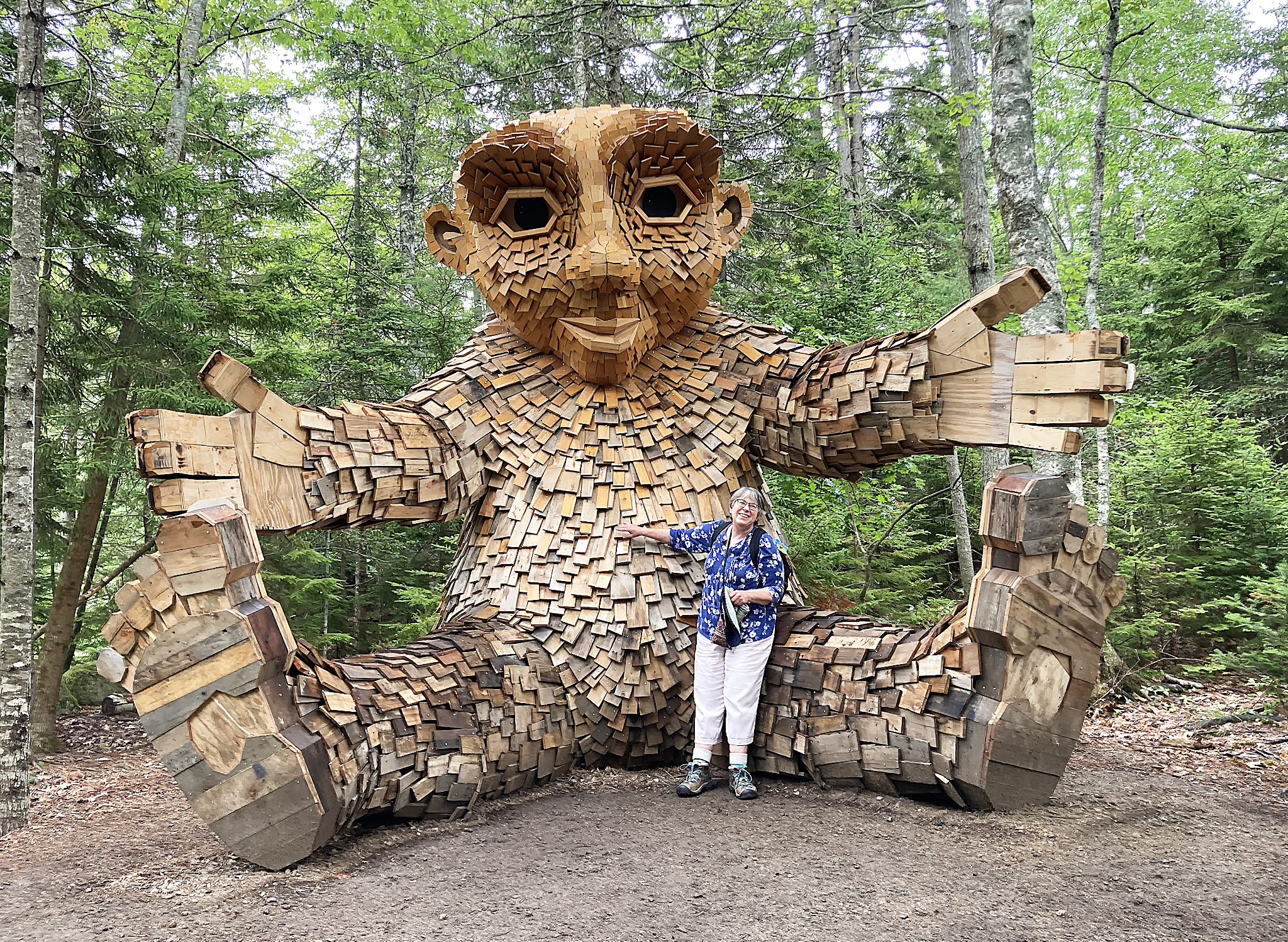
Guardians of the Seeds - Coastal Maine Botanical Garden Trolls

The Trolls, the Trolls! My buddy Shannon, and I, made it to the Botanical Gardens yesterday. What an amazing Troll-filled day we had. Note that all quotes (in brown) are from the information posts about the trolls in the gardens.

ROSKVA

While crossing the bridge from the visitor's center to the gardens proper, I happened to look to my right and spied the first troll, Roskva. Can you see her?

As we got closer, some of Roskva's details and amazing height started to become obvious. I don't know about you, but I was so excited to see this masterpiece of recycled wood. Click here to learn about the artist and the trolls at the Gardens.

When we reached her, up close and personal, I was overwhelmed with her actual size! Until you see the trolls in person, you cannot truly appreciate them! And appreciate them we must as they are the Guardians of the Seeds. 
"Roskva stands for the TRUNK of the tree. Roskva is the heaviest, hardest, and strongest of the trolls. Every day, Roskva climbs towards the sky, and every year she grows taller and wider. If a troll forgets something, they can always ask Roskva–she counts the seasons and remembers everything that happens around her."

A docent was kind enough to take a photo of Shannon and I with Roskva. We were dwarfed by her height!

BIRK
We walked down the Haney Hillside and then along the Shoreland Trail to visit with the next troll.
Oh my goodness! As we rounded a bend in the trail, Birk's head could be seen above the young pine trees.
There he was, lounging on the ground, or so it seemed. You see, "Birk holds the ROOTS of the tree." But there is more to his story...
"Birk is the wisest and most mysterious of the trolls. He hides in the shadows and listens to the whispers of the soil. He knows everything that happens in the wild, and every day he tells tales to all the other creatures of the forest."
"Birk knows that a tree's roots are as big as the branches above it. In the forest, these roots are all connected to each other."
"Trees use this wood-wide web to signal to each other who needs food or who is in trouble from pests and disease."
Shannon posed next to Birk's foot show the scale of this fabulous troll. As he lounges here year after year, the wood that makes him up will return to the soil and nourish the tree roots below.
Of course, I had to have my "troll time" as well!

GRO
We left Birk and made our way toward the Rhododendron Garden. As we traversed the North Trail we came upon GRO.
I felt immediately at peace. "GRO smiles with the LEAVES of the tree."
To know GRO is to love GRO.
"GRO is a wanderer. Every fall she disappears, but the trolls are not worried because every spring she returns to the forest. On her return, GRO walks around to make sure every friend of hers is fed. After hurrying to catch a few sunbeams and a handful of raindrops, she creates a feast for the forest."
Those of us who are lovers of forests appreciate all of the bounty that GRO provides. "Most of us can't eat sunlight, but GRO knows trees can–with their leaves." "Using the Sun, leaves make animal life on Earth possible."

SØREN
After admiring the waterfall and flowering plants in the Rhododendron Garden, we took the Maine Woodland Trail toward Birch Allée.
As we walked, we saw an unusual troll sitting in the middle of the trail with his hair sticking straight back as if the wind was blowing it. SØREN was here.
We followed other visitors and entered this section of the trail under SØREN'S bent knee. First came Shannon,
followed by me. What a funny way to walk a trail! SØREN was so whimsical. 
"SØREN sticks up for the BRANCHES of the tree." And, branches he has for his hair!
"SØREN is a very curious troll; his head is always turning and twisting, searching for places ever higher. He dreams about drifting around on a cloud in the sky, and when the wind is blowing, he loves to celebrate with a dance."
"SØREN can see that up in the branches there is a whole other world. Branches are alive."  Reach for the sky, SØREN!

LILJA
Our last stop was to see one of my favorite trolls. To get to her we hitched a ride down Birch Allée toward the Children's Garden.
Oh my, I felt an instant connection to LILJA. Why is that, you might ask? Well, it is because "LILJA holds the scent of the FLOWERS of the tree." And, for some silly reason, I felt the need to tickle her tummy!
"Just last summer, Lilja came out from her hiding place. The youngest of the trolls, she's still just a child. She loves the colors and the scents of the flowers and when bees and butterflies fly among branches." 
I truly get LILJA because I am the same way. I adore flowers and I truly believe that "Everybody needs flowers!" And, off we went to the Children's Garden where flowers, fairies, veggies, chickens, frogs, and fish thrive! LILJA's spirit is part of everything we saw there! 
By the way, we walked close to 4 miles on this adventure!