Tuesday, August 15, 2017

Herring Gulls at Popham Beach

There were lots of herring gulls at Popham Beach today. We saw adult gulls in breeding plumage with their brilliant white feathers and gorgeous eyes.
Who knew that you could see right through their nostrils to the other side!
And we saw lots of juvenile herring gulls with their dark brown plumage. They look so different from the adults.
This one was chasing after his parent, imploring her for food.
He was definitely saying, "Mom...why won't you feed me? Why?Why?Why?"
And, lastly, Junior showed us his mastery of flight.
This is the same bird as he flies close to the shore. Three shots in progression.
(Click on the panorama for a larger view.)
Junior cruises the shoreline in search of a bite to eat. 

The Many Moods of Fox Island

We always get to Popham Beach just before low tide, so that we can maximize our time walking along the sand bar and climbing on the rocks of Fox Island.
The island is only accessible at low tide, and is a very popular destination when coming to the beach.
It is a big granite outcropping with a large expanse of rock to traverse.
There are lots crevices to jump over...
and tiny caves to explore.
And, if you're a bird, the island gives you a great vantage point from which to keep an eye out for fishing boats filled with the daily catch.

Tide Pools of Fox Island

Fox Island has been around for millions of years. Thus, its surface has weathered due to water (in the form of ice, rain, and waves), wind, and organism activity.
The black, slippery cyanobacteria (Calothrix spp) covers the rock in the supralittoral zone (or splash zone). This most ancient organism is "coated with a slime that prevents them from getting dehydrated at low tide; this also makes the rocks slippery for tide pool-exploring humans." "This black stain marks the limit of high tide, as Calothrix can only tolerate salt water occasionally." 
Schmitt, Catherine. A Coastal Companion: A Year in the Gulf of Maine, From Cape Cod to Canada. Gardiner, Maine: Tilbury House Publishers, 2008. Print.

This weathering has produced depressions that form tide pools; places where water sits until high tide occurs again. Up in this area, water just splashes up from wave action.


The pools range from tiny, shallow puddles, to broad shallow depressions, to deep holes. 


Drew found one of these deeper holes that was about 12-18 inches deep. He tried using the Apeman motion camera underwater, but his attempt did not work this time. We have to keep practicing to really understand how close we can get to an object to still have it in focus. We are shooting blind, so to speak. And, it was so bright out that we couldn't look at the video that we had already taken. That just means that we're going to have to visit the beach again;-)


First I checked out this tide pool, but I wasn't satisfied with it. So, I moved further down into the slick, cyanobacteria covered section.


Because of the cyanobacteria coated rocks, it was super slippery and I couldn't get any traction with my hiking boots. So much so, that I had to inch my way to this tide pool whilst sliding along on my butt! 


Green algae (Ulva intestinalis aka Enteromorpha intestinalis), rock barnacles, red algae (Hildenbrandia spp),
and juvenile black snails (Littorina obtusata maybe;-)
Check out the oxygen bubbles produced by the photosynthesizing green algae!
I hung out at this shallower tide pool and took shots from the top of the pool. Unfortunately, I had forgotten to bring the polarizing filter (gee, we never bring quite everything we need;-), but was able to shade the surface sufficiently to capture some images. I believe the green algae is Ulva intestinalis aka Enteromorpha intestinalis? If so, this algae lives in many different habitats and takes on many different forms.


And, in these tide pools, various organisms, who can handle harsh conditions, thrive. I am not sure what the yellow, jelly-like looking organism is, that is covering the rocks. First I thought it might be related to some kind of encrusting tunicates?  Could the red, jelly-like organism be Hildebrandia spp (red crust algae?) I need to take a tide pooling course from a marine biologist. I have found a good resource blog titled, Between the tides of Nova Scotia. It has lots of photos of marine life. Another fabulous website resource is Rocky Intertidal Habitats Along The Coast of Maine, by Robert Zottoli, Professor Emeritus, Fitchburg University.

And, lastly this part of the pool with some brown algae, Fucus filliformis, fronds (I believe.)

Birds of a Feather Flock Together at Popham Beach

 I would be remiss if I didn't include these birds of a feather that flock together. 
I believe that the bird on the left is a juvenile Sanderling, along with the one in the middle.
I believe that the bird closest to the camera is a Semipalmated Sandpiper, as is the bird farthest back.
Now, my bird identification has proved to be incorrect each and every time I have attempted it,

so I could be wrong;-)

Semipalmated Sandpiper (I believe)


And, now for the two birds of a feather who have stuck it out through 27+ years of marriage and are still going strong. How? Shared interests in nature, photography, computers, clean living, and strong ethics.
Drew - experimental photographer, all around photographer, and iMovie maker.
Laurie - primary photographer
This is as photogenic as I get;-)
Hi Mom! Wish you were here!😎

A Pot of Gold - Tomatoes that is!

Ahhh... the sweet taste of Sun Gold tomatoes. 
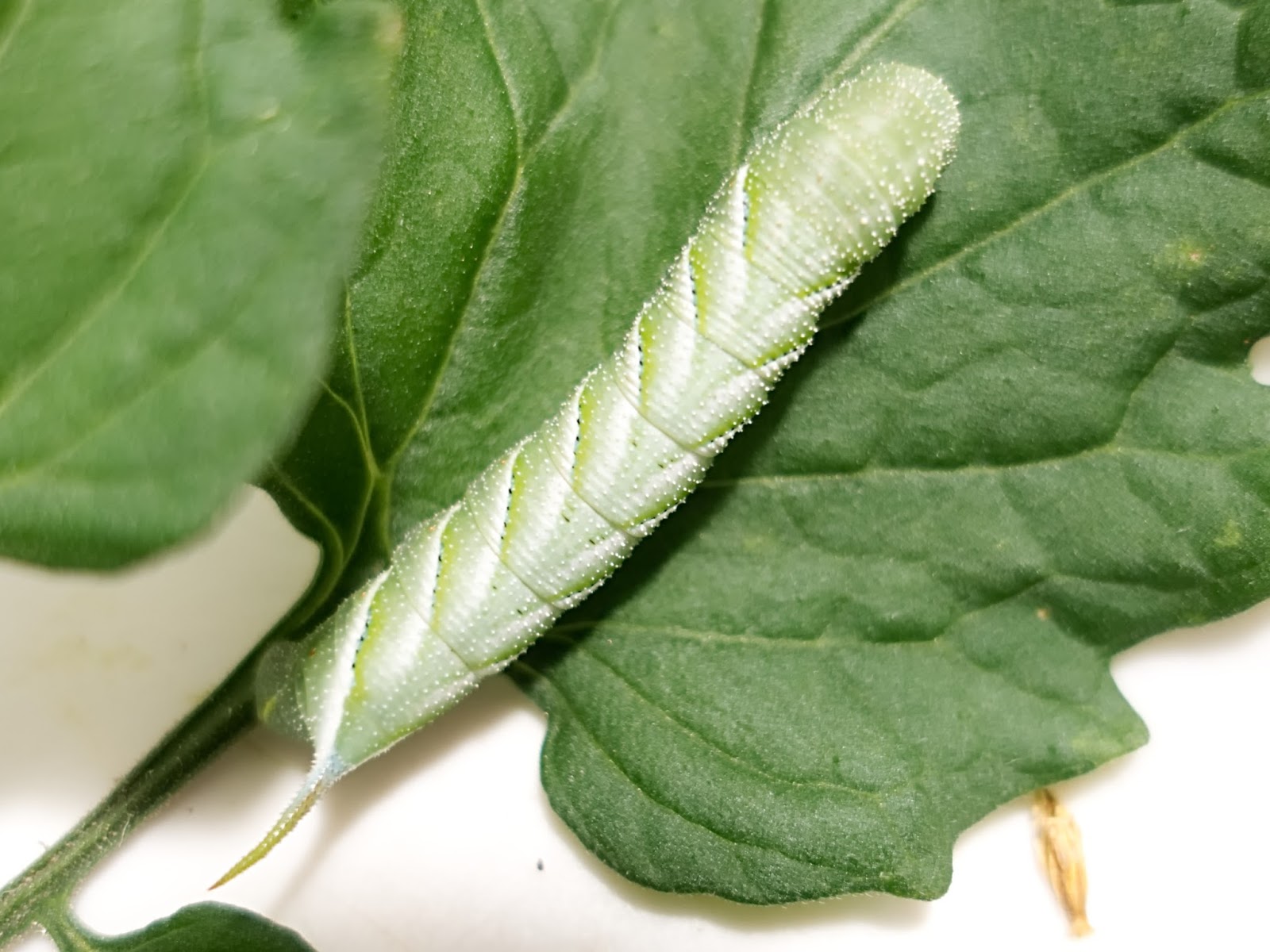
The fruits of our labor in the partial eradication of tomato hornworms;-) I say "partial" because there is no way we'll get them all. But, at least we are trying to stay ahead of them as much as we can. I picked 1.5 pints of tomatoes this morning.

Tomato Hornworm Update

Tomato Hornworm Tally: 14 tomato hornworms thus far.

August 20th Update: 20 hornworms total with no more in sight!

Monday, August 14, 2017

Find the poop, find the Tomato Hornworm

Daily Tomato Hornworm Tally: 12 tomato hornworms in three days.
This morning we searched for more tomato hornworms as I found poop under several plants. So, we looked nearby for branches with leaves that had been munched.
And, lo and behold, we found two more caterpillars. I think we missed a few, but Drew swept off the deck again, and we'll do our UV light search and kill tonight.

Sunday, August 13, 2017

Tomato Hornworm Update

My strategy worked! I swept the deck this morning, and this afternoon Drew went out and looked for caterpillar poop. He found some under several plants. When you find the poop, look up at the tomato plant branches directly above the poop. You might see some half-eaten leaves. Look under the leaves, and behold the dastardly herbivores!
Total thus far: 10 dastardly tomato hornworm caterpillars.
This afternoon's caterpillar count: 5 more tomato hornworms, but they were all smaller than the ones found last night!

Saturday, August 12, 2017

Shining for Tomato Hornworms

Tomato hornworm caught in the act of defoliating a tomato stem.
Tomato hornworms fluoresce a bit when using a long-wave UV flashlight.
So, what are you doing on this beautiful Saturday evening? Something as exciting as us, I hope! Yup, we're shining for tomato hornworm caterpillars. In my youth, I would get together with friends and shine for gators, possums, and deer (always an adventure;-) But, now that I am older, I prefer the more sedate act of peering under tomato leaves in search of caterpillars that are munching my plants to death. Drew found that using our long-wave UV flashlight really lit up the caterpillars and made it so easy to see them. Whoooo! This is about all the excitement I can handle;-) Tonight's tally: 5 good-sized caterpillars.

Here is a view of a young tomato hornworm, recently plucked from one of the tomato plants, shortly before meeting its doom. Tomorrow morning, I am going to sweep all the hornworm poop off the deck and then check again tomorrow evening to see if there is more poop in evidence. Then, we'll check the underside of the leaves, nearest the poop, to find the caterpillars and help them meet their doom, repeat, repeat, repeat. I know, I know...I should leave one sacrificial tomato plant for them to chow upon, but, but, but...maybe next year!

A City Girl's Garden

We have been enjoying the fruits of our labor, garden-wise. I bought Sun Gold cherry tomato plants for our front deck garden this year as our deck is like an oven all summer long.
The tomato plants look like mutants on our deck. I laugh every time they remind me of the cartoon, Calvin and Hobbes' mutant snowmen. We didn't have any cage material, so I just put a couple of stakes into the pots. Well...as  you can see, these plants really seem to like to sprawl;-) Drew had to prop up the pots with bricks so that the pots don't fall over from the weight of the leaning plants.
Here are our new favorite tomatoes, Sun Gold. Beautiful and delicious. They are yellow tomatoes, and are sweet as can be. I am going to make sure to purchase this variety again next year. Yuuuummmmmeeeee.
Oh yes, we also have zucchini! We eat zucchini every day this time of year. We have two of the most vigorous plants we've ever grown. We think that the difference from other years is that Drew put lots of fertilizer into the soil as the zucchini seem to be heavy feeders.
The payoff from watering daily and pampering the plants is this! Lots of nice, big, beautiful zucchini!